Tracing Correlations Between Daylight Saving Adjustments and Automated Backup Schedule Disruptions in Distributed Household Device Fleets
Written by Willa Müller · Jul 1, 2026
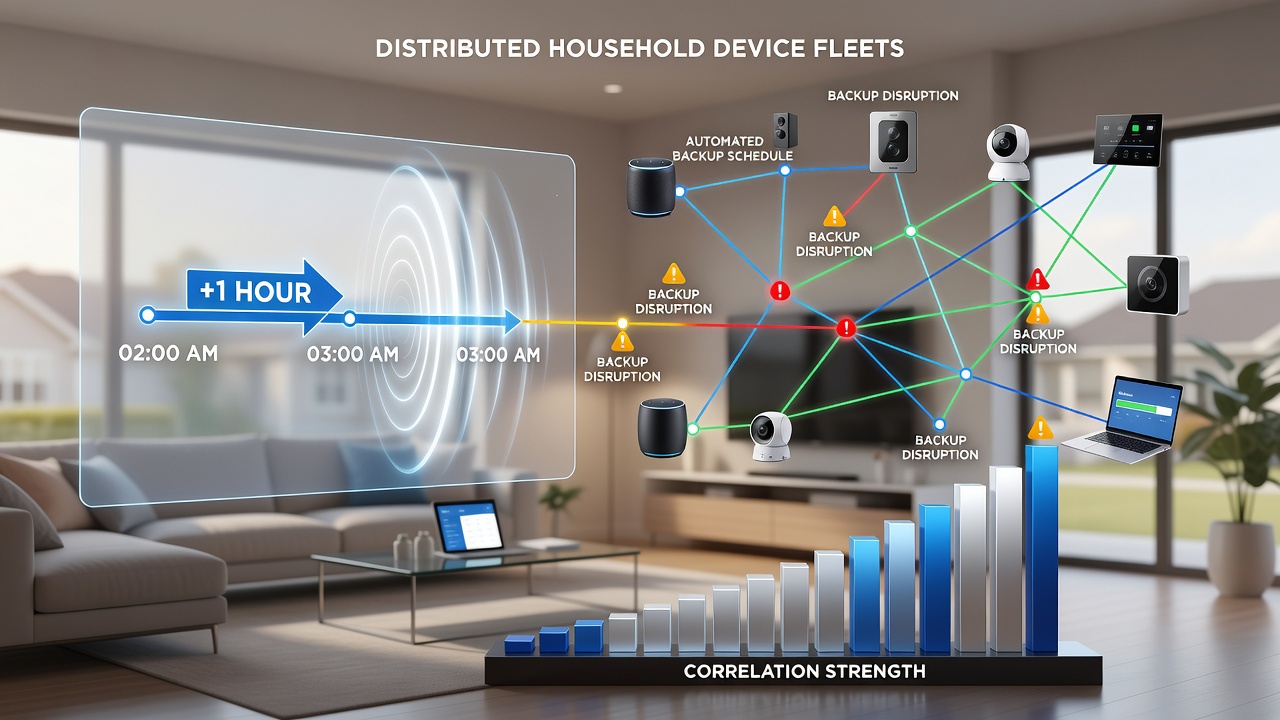
Tracing Correlations Between Daylight Saving Adjustments and Automated Backup Schedule Disruptions in Distributed Household Device Fleets
Daylight saving time adjustments create measurable shifts in system clocks across regions that observe seasonal changes, and these shifts intersect with the scheduling mechanisms that govern automated backups on household devices. Devices ranging from smart home hubs to networked storage units rely on internal time references to trigger routines, yet the biannual clock movements introduce offsets that can misalign those triggers. Observers note that in households with multiple gadgets running independent operating systems the resulting discrepancies appear as skipped executions, duplicated runs, or partial transfers that leave data sets incomplete.
Mechanics of Time Adjustments in Device Networks
Most consumer devices pull time from network time protocol servers or maintain local clocks that respond to regional daylight saving rules stored in operating system databases. When clocks advance or retreat by one hour the scheduled tasks anchored to wall-clock time encounter an hour that either repeats or disappears. Research from timing laboratories indicates that backup scripts configured for 2:00 a.m. on transition days often encounter conflicts because the hour between 2:00 a.m. and 3:00 a.m. is either absent in spring or duplicated in fall. Distributed fleets amplify the effect because each device may apply its own locale settings or receive updates at slightly different moments, producing staggered responses within the same home network.
Observed Patterns in Backup Execution
Data collected from household monitoring projects shows elevated rates of incomplete backup logs during the weeks surrounding clock changes. Devices running continuous synchronization protocols sometimes initiate transfers based on elapsed time counters rather than absolute clock values, which creates another layer of variance when daylight saving corrections propagate through the network. Figures from academic logging studies reveal that routers and attached storage units experience brief desynchronization windows lasting several minutes while firmware updates time-zone tables, and those windows coincide with backup daemons attempting to write new archive files. The result appears as fragmented snapshots that require manual reconciliation later.
Regional Policy Influences on Device Behavior
Policy decisions about whether to retain daylight saving time affect the frequency of these events. Jurisdictions that maintain seasonal shifts continue to impose the twice-yearly adjustment, whereas regions that have abandoned the practice report steadier backup reliability metrics. According to records maintained by NIST time services, households in areas with active daylight saving observance log higher numbers of rescheduled backup events each spring and autumn. In contrast, locations that standardized year-round time show fewer interruptions tied to clock movement, although other variables such as firmware age still contribute to timing drift.

July 2026 marks a point at which several research groups plan to release updated datasets covering five years of household telemetry. Those datasets are expected to include granular timestamps from distributed device fleets that span multiple time-zone boundaries, allowing finer-grained analysis of how cumulative clock adjustments compound across mesh networks. Preliminary summaries circulated among timing researchers suggest that the correlation between transition weekends and backup anomalies persists even after operating system vendors introduced more robust handling of daylight saving transitions.
Device-Specific Scheduling Behaviors
Operating systems handle recurring tasks through different schedulers, each with its own tolerance for clock jumps. Linux-based appliances often use cron entries expressed in local time, whereas certain embedded controllers rely on epoch seconds that remain continuous across the adjustment. When a mixed fleet contains both types the backup orchestration layer may receive conflicting signals about whether a daily job has already executed. Case logs compiled by university engineering teams document instances where a single home network produced three separate backup attempts within a four-hour window because one device advanced its clock while another lagged behind pending a manual confirmation prompt.
Network-Level Propagation Effects
Network-attached storage units frequently coordinate with cloud endpoints that operate on coordinated universal time. The translation between local daylight saving time and universal time occurs inside device firmware or companion applications, and any mismatch during the transition window can shift the perceived deadline for an incremental backup. Reports compiled by European research consortia indicate that latency spikes on residential broadband during transition weekends further delay the completion of these handshakes, producing cascading delays that appear in subsequent days as backlogs of queued archive files.
Conclusion
Correlations between daylight saving adjustments and backup disruptions emerge consistently across documented household environments because scheduled tasks depend on time references that change abruptly twice each year. The patterns appear in log files as skipped executions, duplicated transfers, and partial archives, with greater frequency in fleets that combine devices from multiple vendors. Continued collection of telemetry through 2026 and beyond will supply additional quantitative detail on how these timing events interact with evolving device firmware and network protocols.