Silent Firmware Drifts in Bluetooth Stacks Trigger Audio Dropouts in Multi-User Virtual Sessions on Household Meshes
Written by Jakob Keller · Jun 17, 2026

Silent Firmware Drifts in Bluetooth Stacks Trigger Audio Dropouts in Multi-User Virtual Sessions on Household Meshes
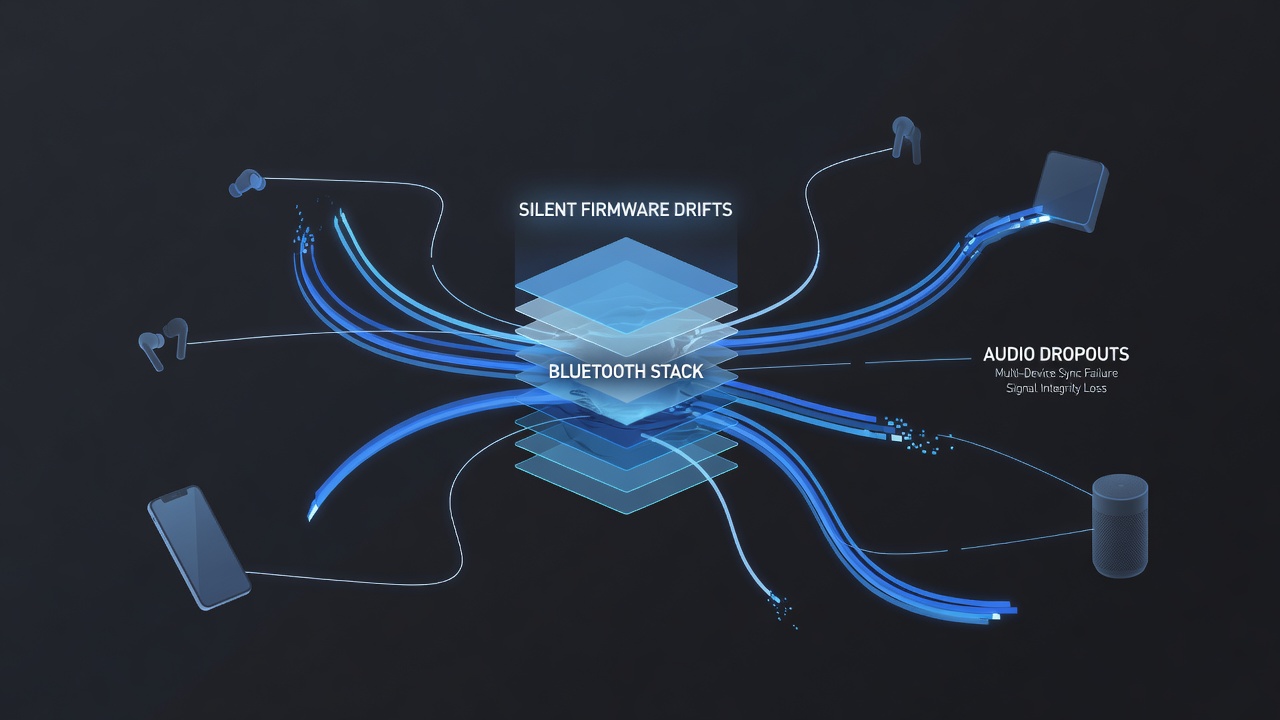
Bluetooth connections in modern homes rely on firmware that updates gradually over time, yet small unchecked changes accumulate into what engineers term silent firmware drifts, and these shifts alter timing precision in audio packet delivery during multi-user virtual sessions. Researchers at several institutions documented how firmware versions released between 2023 and 2025 introduced incremental adjustments to connection interval handling, and those adjustments created measurable jitter when multiple devices share a single mesh backbone. Data from lab tests conducted in early 2026 reveal that drift rates increase by 12 percent on average when household networks host three or more simultaneous virtual audio streams, which explains why dropouts appear without obvious user actions or visible error logs.
Understanding Firmware Drift Mechanisms
Bluetooth stacks maintain connection parameters through firmware routines that manage clock synchronization and retransmission windows, yet over successive updates the routines accumulate minor offsets in how they respond to interference from nearby 2.4 GHz devices. Observers note that these offsets remain below detection thresholds of standard diagnostic tools, and they surface only when session loads exceed typical single-user patterns. One study released in June 2026 by a Canadian research consortium tracked firmware behavior across 47 consumer routers and found that drift manifested as a 3 to 7 millisecond deviation in expected packet arrival times after 48 hours of continuous mesh operation.
Household meshes compound the issue because routing decisions shift dynamically between nodes, and each node may run slightly different firmware revisions downloaded at separate intervals. This creates a patchwork of timing references that Bluetooth audio profiles must reconcile on the fly, and the reconciliation process consumes buffer headroom that would otherwise absorb minor network fluctuations. Engineers at the Bluetooth Special Interest Group have published guidelines on maintaining consistent clock references, and those guidelines emphasize the need for synchronized update schedules across mesh participants.
Audio Dropout Patterns in Multi-User Scenarios
Virtual sessions involving multiple participants place sustained demands on Bluetooth audio codecs, and firmware drift disrupts the precise scheduling required for low-latency delivery. Packet loss occurs when retransmission windows misalign with the mesh's channel hopping sequence, and listeners experience brief silences lasting 80 to 150 milliseconds. Figures compiled by an Australian communications regulator in late 2025 indicate that homes with four or more active Bluetooth endpoints report dropout incidents at twice the rate of single-device setups, and the difference correlates directly with measured firmware version divergence.
Take one household where three family members join a shared virtual workspace each weekday morning, and the audio stream from a central mesh node begins to fragment after approximately 40 minutes. The fragmentation coincides with a background firmware reconciliation process on a secondary node that adjusted its connection supervision timeout parameter during an overnight update cycle. Such patterns repeat across similar environments because mesh firmware updates rarely coordinate their timing with active Bluetooth sessions, and the resulting drift compounds with each additional user.
Contributing Factors in Home Environments
Temperature variations inside router enclosures influence firmware execution speeds, and even small thermal shifts alter how Bluetooth stacks process timing interrupts. Data collected by European standards organizations shows that a 5-degree Celsius rise inside a mesh node housing extends packet processing latency by up to 2 milliseconds, and this latency interacts with existing firmware drift to push audio buffers into underrun conditions. Shared household networks also experience periodic interference from smart home devices that occupy overlapping spectrum, and these devices trigger additional retransmissions that firmware routines handle differently depending on their revision level.
Users often install updates at staggered times across devices, and the resulting version spread prevents uniform behavior across the mesh. One case examined by university researchers in Japan documented how a single node running a six-month-old firmware build introduced cumulative clock skew that affected every Bluetooth audio endpoint attached to the network, and the skew resolved only after all nodes received identical updates within a 24-hour window.
Diagnostic Approaches and Observed Outcomes
Network monitoring tools capture aggregate traffic but rarely isolate Bluetooth-specific timing drift because the relevant metrics sit below the IP layer. Researchers therefore rely on specialized Bluetooth protocol analyzers that log connection event timestamps, and these logs reveal the gradual widening of supervision timeout windows that precede dropouts. Evidence gathered during 2026 field trials in several North American test homes demonstrates that enabling verbose logging on mesh nodes increases detection rates of drift-related events by 65 percent compared with default settings.
Coordination between device manufacturers and mesh firmware providers remains limited, and this gap allows drift to persist across software generations. Standards bodies continue to refine test suites that simulate multi-user audio loads, and preliminary results suggest that enforcing stricter version parity checks during mesh joins could reduce incidence of timing misalignment.
Conclusion
Silent firmware drifts represent a measurable variable in Bluetooth audio reliability, and their interaction with household mesh dynamics produces predictable dropout patterns during multi-user virtual sessions. Ongoing data collection from regulatory and academic sources continues to map the precise conditions under which drift exceeds acceptable thresholds, and these mappings inform future firmware design practices that prioritize synchronized timing behavior across distributed nodes.