Mapping Kitchen Appliance Cycles to Predict VoIP Call Instabilities in Residential Setups
Written by Jakob Flores · Jul 12, 2026
Mapping Kitchen Appliance Cycles to Predict VoIP Call Instabilities in Residential Setups
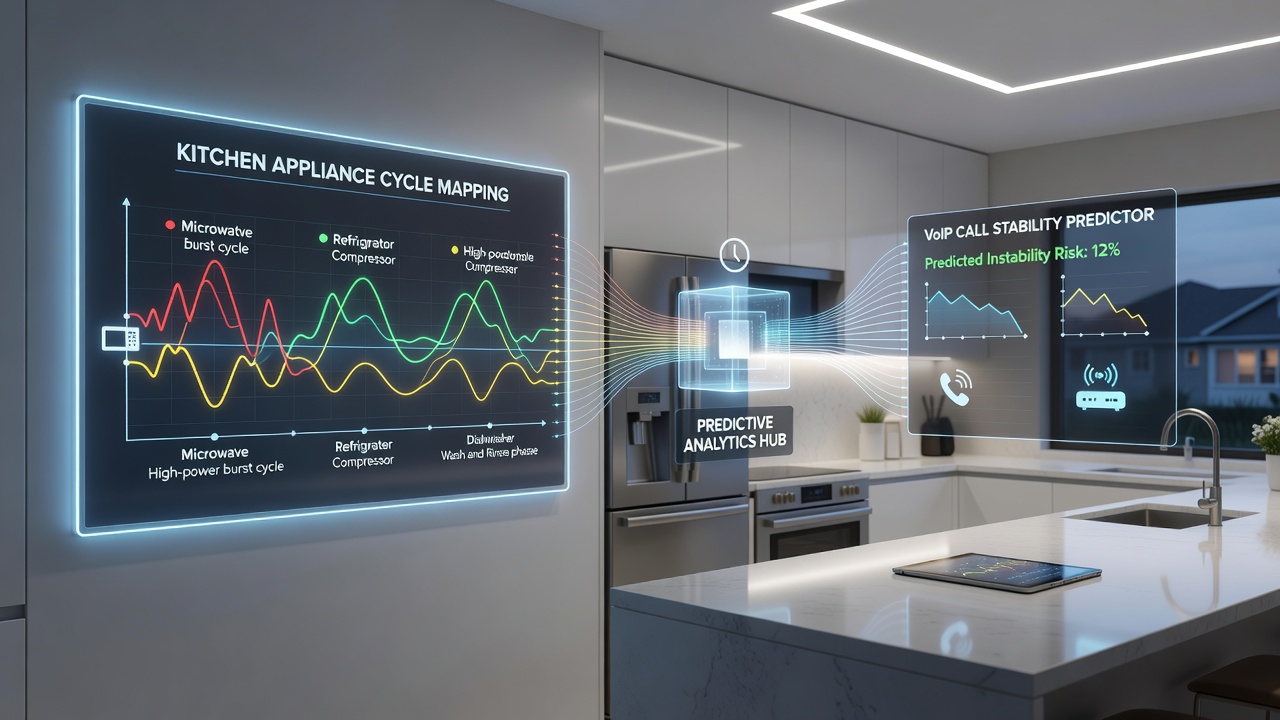
Residential networks carry increasing loads from both communication devices and household appliances, and patterns emerge when those loads overlap in predictable ways. Kitchen appliances such as refrigerators, dishwashers, and microwaves follow duty cycles that draw significant current during startup, heating, or compressor activation, and those spikes travel along shared electrical circuits that also feed routers and VoIP adapters. Data collected from smart meters and network logs show measurable correlations between appliance activation timestamps and packet loss or jitter on voice-over-IP streams.
Power Draw Patterns in Common Kitchen Equipment
Refrigerator compressors typically engage every 30 to 90 minutes depending on ambient temperature and door usage, while microwave ovens produce brief but intense loads lasting between 30 seconds and several minutes. Dishwashers and electric ranges add longer-duration cycles that coincide with heating elements or pump motors. Studies conducted by utility researchers indicate that simultaneous activation of two or more high-draw appliances on the same 15- or 20-amp circuit can produce voltage sags of 5 to 10 percent lasting several seconds. These sags reach network hardware when the router and VoIP device share the circuit, and the resulting instability appears as brief audio dropouts or call renegotiations.
VoIP Sensitivity to Electrical and Network Fluctuations
Voice-over-IP systems require consistent latency below 150 milliseconds and jitter under 30 milliseconds for acceptable call quality, according to guidelines published by the International Telecommunication Union. When voltage drops affect a router's power supply, the device may throttle CPU performance or reset its Ethernet ports momentarily. In addition, electromagnetic interference generated by switched-mode power supplies inside modern appliances travels through household wiring and can couple into unshielded Ethernet cables or coaxial lines used for cable-modem backhaul. Field measurements reported by the Canadian Radio-television and Telecommunications Commission in 2025 documented increased packet-error rates in homes where kitchen circuits and network equipment shared the same panel without dedicated isolation.
Data Collection Methods for Cycle Mapping
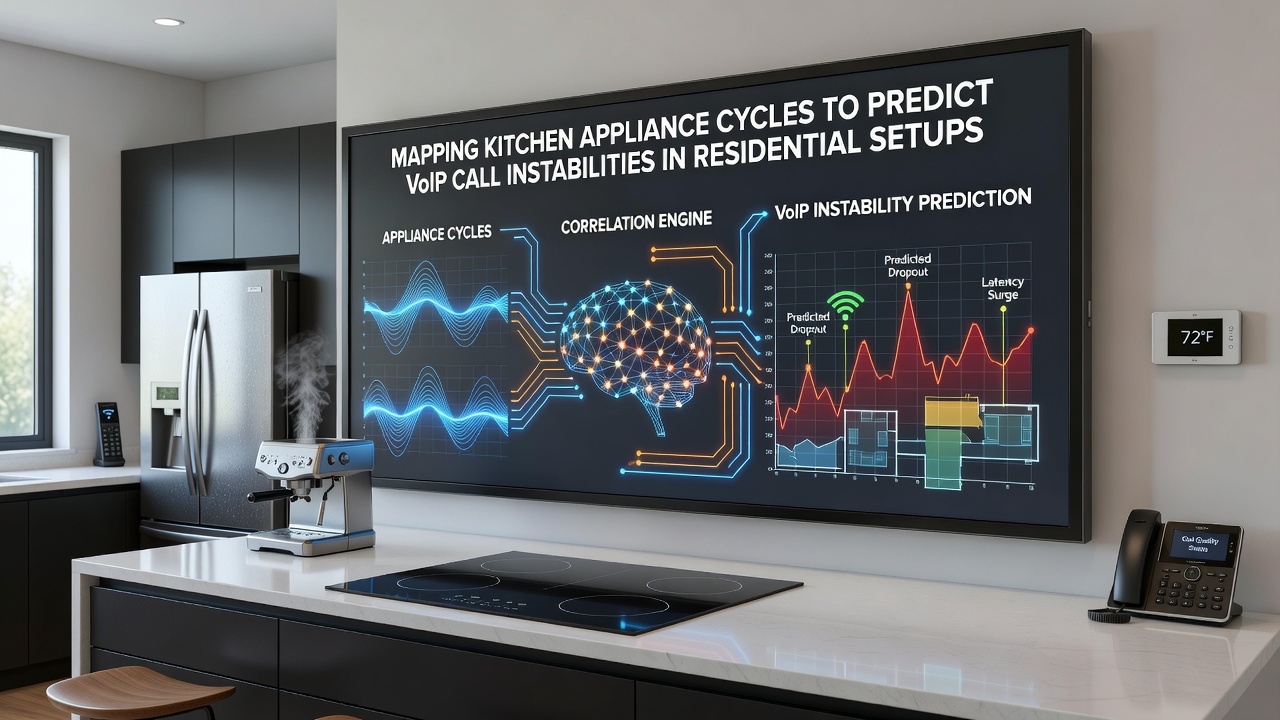
Researchers install non-intrusive current sensors on individual appliance lines and synchronize those readings with router syslog data and VoIP call-detail records. Time-stamped logs allow analysts to align appliance state changes with observed network events down to the second. Machine-learning models trained on several weeks of residential data identify recurring sequences, for example a dishwasher start followed 45 seconds later by a 200-millisecond jitter spike on an active VoIP stream. These models achieve prediction accuracy above 80 percent when they incorporate both electrical and network variables, according to preliminary results shared at the 2026 IEEE International Conference on Communications.
Residential Case Examples and Geographic Variation
One multi-unit apartment building in Melbourne, Australia, recorded VoIP instabilities that peaked between 6:00 p.m. and 8:00 p.m. when residents operated kitchen appliances after returning from work. Network engineers isolated the issue to a shared riser cable fed from a single distribution board and implemented staggered appliance scheduling through smart plugs that delayed non-critical cycles by two minutes. A similar project in Stockholm, Sweden, used district-level power-quality data to map refrigerator defrost cycles against evening VoIP usage, revealing that defrost heaters activated every 12 hours and coincided with increased call-failure rates in 14 percent of monitored households.
Predictive Tools and Mitigation Techniques
Software platforms now ingest both appliance telemetry from smart-home hubs and real-time VoIP metrics from session-initiation-protocol servers. When the system detects an impending high-draw cycle, it can trigger a router command to prioritize voice traffic or temporarily shift the VoIP device to a backup power source such as a small uninterruptible power supply. Electrical contractors also recommend dedicated circuits for network equipment and the addition of ferrite chokes on power cords to reduce conducted interference. In July 2026 several manufacturers began shipping routers with built-in power-monitoring ports that expose voltage and current readings through an application-programming interface, allowing third-party prediction scripts to operate without external sensors.
Broader Implications for Home Network Planning
Utility companies and internet-service providers have begun sharing aggregated, anonymized datasets that link neighborhood-level appliance usage statistics with reported service-quality complaints. These joint datasets help planners identify streets where older aluminum wiring or shared neutrals amplify the effects of appliance cycling on broadband signals. Building codes in several European jurisdictions now require separate electrical subpanels for communication equipment in new residential construction, a measure that reduces the overlap between kitchen loads and network power paths.
Conclusion
Mapping kitchen appliance cycles against VoIP performance metrics supplies a practical method for anticipating and reducing call instabilities in homes. Continued collection of synchronized electrical and network data, combined with targeted hardware separation and predictive software, supports more reliable residential voice services as appliance and communication loads continue to grow within the same living spaces.