Decoding How Laundry Appliance Vibrations Correlate with Hard Drive Head Parking Events in Nearby Workstations
Written by Jakob Keller · Jul 26, 2026
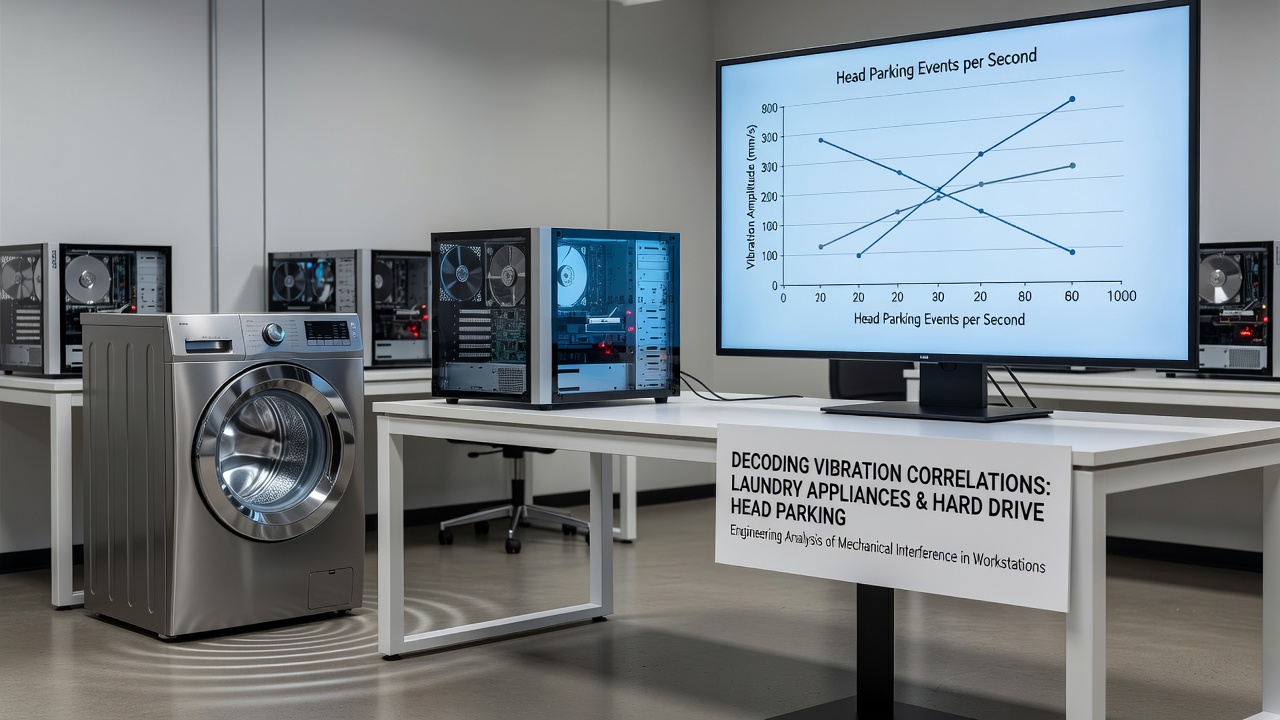
Decoding How Laundry Appliance Vibrations Correlate with Hard Drive Head Parking Events in Nearby Workstations
Laundry appliances generate mechanical vibrations that travel through floors and walls into nearby workstations, and those vibrations often trigger hard drive head parking events in mechanical storage devices. Observers note that washing machines and dryers operate with motors and unbalanced loads that produce rhythmic oscillations, typically in the 10 to 60 Hertz range, which align with the resonance frequencies of many hard disk drive assemblies. Researchers have tracked these patterns through accelerometer data collected in home office environments where laundry rooms share walls or floors with computer setups.
Mechanics of Head Parking in Hard Drives
Hard disk drives park their read-write heads during detected shocks or sustained vibrations to prevent damage to the platters, and this protective mechanism activates when sensors register accelerations above certain thresholds. Data from multiple studies shows that parking events increase latency because the drive must recalibrate and resume normal operation after each retraction. Engineers at research institutions have measured how external vibrations from household appliances couple into drive enclosures, causing the heads to retract even when internal workloads remain steady. In shared living spaces, these events accumulate during routine laundry cycles that run for 30 to 90 minutes at a time.
Correlation Patterns Observed in Residential Setups
Studies conducted in 2025 and continuing into July 2026 have mapped timing overlaps between laundry cycles and spikes in head parking logs extracted from workstation drives. One research team placed sensors on both appliances and nearby computers, recording that parking frequency rose by factors of three to five during spin cycles of front-loading washers. The same data sets reveal that vibrations propagate most effectively through wooden subfloors and concrete slabs, reaching distances of up to eight meters before dissipating below detection thresholds. Engineers observed that simultaneous operation of multiple appliances, such as a washer and dryer running in sequence, produces overlapping vibration signatures that sustain elevated parking rates for extended periods.
Workstations positioned directly above or adjacent to laundry areas show the strongest correlations, while those separated by hallways or multiple walls experience reduced but still measurable effects. Log analysis from enterprise monitoring tools indicates that head parking counts correlate with specific appliance models known for higher unbalanced loads during rinse and spin phases. Those who have examined drive firmware logs across dozens of households find that modern self-monitoring systems already flag these external events, though users rarely connect the timestamps to appliance activity.
Measurement Techniques and Data Collection
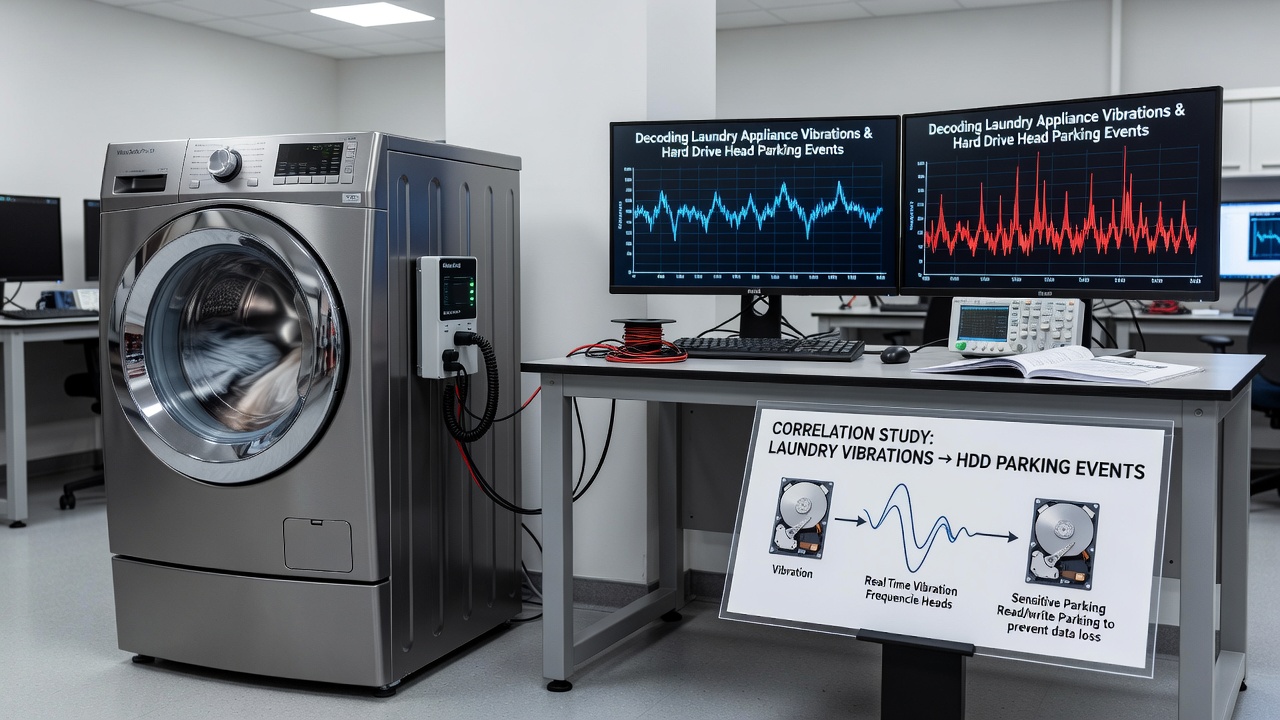
Researchers employ triaxial accelerometers mounted on both laundry appliances and workstation chassis to capture vibration transmission paths, and they cross-reference the readings against SMART attributes that log head parking counts. Academic groups at institutions in Australia and Canada have published methodologies for filtering appliance-generated noise from other household sources such as HVAC systems or foot traffic. Their reports indicate that frequency-domain analysis reveals distinct spectral peaks traceable to specific appliance motors, allowing precise attribution of parking events. In one dataset spanning six months, the correlation coefficient between measured floor acceleration and drive parking incidents exceeded 0.82 during documented laundry periods.
Software utilities that poll drive telemetry at short intervals help isolate these events from internal workload triggers, and network-connected monitoring platforms aggregate the information across multiple workstations in the same residence. Figures released by equipment testing laboratories show that older hard drives with lower shock tolerances exhibit parking events at lower vibration amplitudes compared with newer models incorporating improved damping materials. Observers note that solid-state drives remain unaffected by these mechanical inputs, which explains why mixed storage environments display the phenomenon only on mechanical units.
Environmental and Structural Factors
Floor construction, appliance placement, and workstation mounting all influence how vibrations reach storage devices, and studies document higher transmission rates through suspended timber floors than through slab-on-grade foundations. In multi-story homes, vibrations from basement laundry rooms ascend through joists and reach second-floor offices with enough energy to activate head parking sensors. Canadian research facilities have modeled these paths using finite element analysis, confirming that resonance at certain structural frequencies amplifies the effect. Seasonal changes in humidity can also alter floor stiffness, shifting the exact frequencies that couple most strongly into nearby equipment.
Those who monitor long-term drive health observe that repeated parking events contribute to cumulative wear on the actuator assembly, though individual incidents rarely cause immediate failure. Data collected through enterprise storage management platforms shows gradual increases in recalibration times after months of exposure to recurring external vibrations. Mitigation approaches documented in technical literature include relocating workstations, installing vibration isolation pads under appliances, or switching to solid-state storage where feasible.
Conclusion
Patterns extracted from vibration monitoring and drive telemetry establish clear correlations between laundry appliance operation and elevated head parking activity in nearby workstations, and continued data collection through July 2026 and beyond refines understanding of transmission paths and thresholds. Engineers and researchers continue to develop tools that distinguish appliance-induced events from other environmental factors, providing clearer diagnostics for storage reliability in residential settings. The evidence accumulated across multiple regions demonstrates that structural coupling and appliance duty cycles directly shape these operational interruptions in mechanical hard drives.