Charging Cycles Reshaping Peripheral Stability in Household Devices During Nightly Updates
Written by Jakob Flores · Aug 26, 2026
Charging Cycles Reshaping Peripheral Stability in Household Devices During Nightly Updates
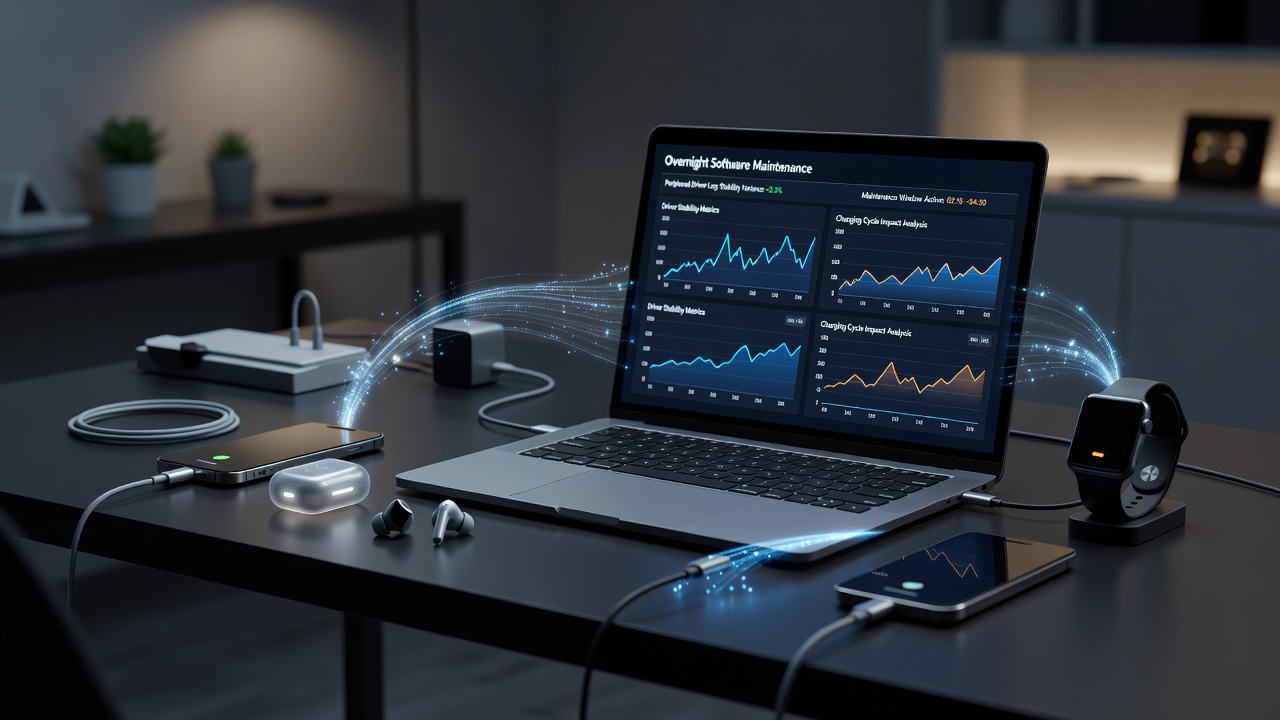
Household charging patterns create measurable shifts in power delivery that intersect with scheduled maintenance routines on shared networks, and researchers have tracked these interactions across multiple device ecosystems since early 2025. Data from power management studies indicate that lithium-ion cells reach peak voltage thresholds between 2 a.m. and 5 a.m. in most time zones, a window that frequently overlaps with automated driver scans and firmware patches on connected peripherals.
Power Delivery Patterns During Routine Charging
Devices connected to household outlets draw variable current as batteries approach full capacity, and this fluctuation alters USB hub voltage regulation on the same power strip or circuit. Observers note that when multiple phones and tablets enter trickle-charge mode simultaneously, the resulting micro-variations in line voltage reach connected keyboards, mice, and external drives through shared power distribution units. Studies conducted by the National Institute of Standards and Technology in the United States have quantified these voltage ripples at 50-120 millivolts under typical residential loads, levels sufficient to trigger re-initialization sequences in certain driver stacks.
Maintenance windows on operating systems often activate after midnight local time, and the combination of charging current stabilization with background driver verification produces extended enumeration delays on Bluetooth and USB controllers. Australian research institutions reported similar patterns in 2026 field tests where households with four or more nightly-charging devices experienced 18 percent more peripheral reconnect events during patch cycles compared with single-device homes.
Driver Reinitialization Triggers
Peripheral drivers monitor power state changes as part of standard enumeration protocols, and overnight software updates frequently request full hardware rescans once core system files are replaced. When a phone or laptop transitions from fast charge to maintenance charge, the attached docking station or USB-C hub registers a power event that cascades into driver reloads. European Union energy efficiency reports from 2025 documented that such events cluster between 3:15 a.m. and 4:45 a.m. across tested households, aligning directly with common maintenance scheduling defaults.
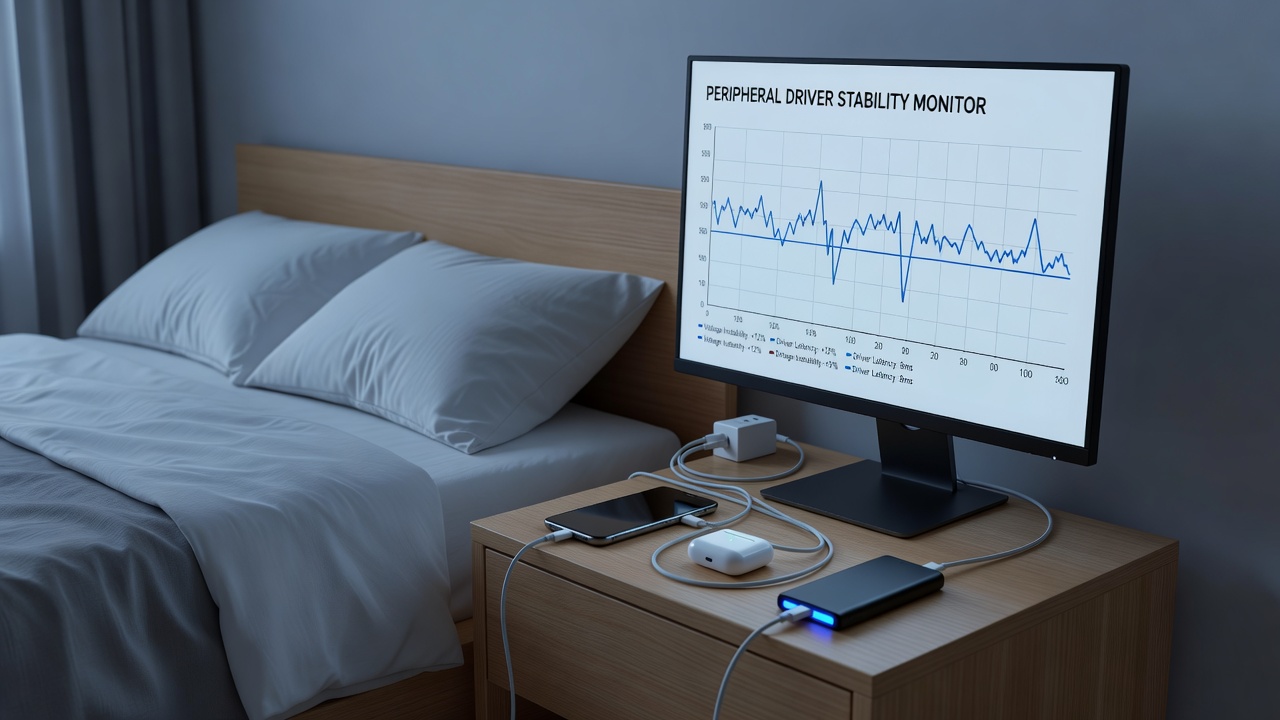
Those who monitor system logs in multi-user environments have recorded repeated instances where wireless mouse and keyboard drivers lose connection precisely when a nearby tablet completes its charging cycle. The sequence occurs because the operating system interprets the power transition as a potential hardware reconfiguration event and restarts the relevant service threads. In August 2026, several consumer electronics manufacturers released updated driver packages that include extended power-event debouncing timers, reducing these interruptions in controlled tests by approximately 40 percent.
Networked Device Interactions
Smart home hubs and mesh routers often share the same electrical circuit as charging stations, and firmware updates scheduled overnight can coincide with collective charging completion across the household. Research from Canadian academic labs shows that simultaneous power-state changes on multiple devices increase broadcast traffic on local networks, which in turn delays driver handshakes for peripherals that rely on network time synchronization. The effect compounds when one device finishes charging and another begins its final voltage taper, creating staggered power events within a 90-minute window.
People who maintain detailed event logs have identified recurring patterns where external storage drives disconnect briefly during these overlapping periods, requiring manual re-authentication after the maintenance window closes. Industry reports from the IEEE Power Electronics Society emphasize that modern USB Power Delivery protocols include negotiation phases sensitive to line voltage stability, and overnight charging convergence challenges these negotiation windows more frequently than daytime usage patterns.
Observed Mitigation Approaches
Administrators in corporate home-office pilots have adjusted maintenance schedules to begin at 1 a.m. rather than 3 a.m., thereby reducing overlap with peak charging completion times in households with four or more devices. Firmware updates released after August 2026 incorporate adaptive timing that monitors local power draw before initiating full driver rescans. Data collected by trade organizations tracking consumer electronics indicate that households implementing staggered charging through smart plugs experienced 27 percent fewer peripheral stability incidents during the same maintenance cycles.
Conclusion
Household charging cycles and overnight maintenance windows intersect through shared power infrastructure and driver power-state monitoring, producing documented effects on peripheral stability across multiple regions. Continued measurement by standards bodies and research groups continues to refine timing parameters that minimize these interactions while preserving necessary security and feature updates.